A Conversation with Playwright Olivia Dufault, “For Want of a Horse,” Echo Theater Company, Atwater Village Theatre
How a formally conventional love triangle becomes a vehicle for the unsayable
(c) what-the-butler-saw.com
March 25, 2026
By James Scarborough
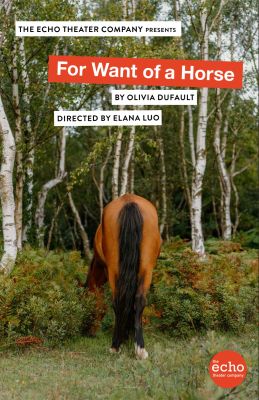
Desire is comedy’s oldest engine. What makes Olivia Dufault’s “For Want of a Horse” distinctive is the precision with which she points that engine at the unsayable. The world premiere at Echo Theater Company takes as its starting point a 2014 New York magazine piece about a man in a romantic relationship with a horse. That Dufault found the article not merely provocative but genuinely moving tells you something about the kind of playwright she is. Her interest lies not in the taboo as spectacle, but in what it reveals about longing, self-knowledge, and the limits of empathy. Calvin, played by Joey Stromberg, is devoted to his wife Bonnie (Jenny Soo) and devoted, too, to Q-Tip, the horse he loves. The premise is absurdist, but the emotional architecture beneath it is recognizable: a man who wants more than one life, and a marriage tested by his honesty about that want. Director Elana Luo, Echo’s associate artistic director, holds a delicate brief. The play promises to be genuinely funny while refusing to let the audience off the hook of its discomfort. Dufault’s track record suggests she can hold those tensions. Her plays Year of the Rooster and The Tomb of King Tot both earned New York Times “Critic’s Pick” designations, and the Venturous Playwrights Fellowship awarded for this script signals that the theatrical community has recognized something consequential here. “For Want of a Horse” might well turn on whether love, rendered absurd enough, still reads as love. Given Dufault’s gift for “conflicting emotions,” in her own phrase, the answer may surprise us. Below follows an email conversation with Olivia Dufault. JS: You’ve said that reading the source article left you captivated, horrified, and amused simultaneously, and that whenever you feel those three things at once you know you have a story worth pursuing. That’s a fairly specific internal diagnostic. How did you learn to trust it, and does writing comedy about genuinely difficult material require a different kind of nerve than writing drama? OD: I write first and foremost for myself, so trusting my impulses is really as simple as asking: is this a story that I’d be excited to experience? I’ve always had a strong sense of taste. I’m making the work I want to see in the world, it just happens to be about horse smut. I think writing any story is pretty nervy! Especially in theater. You have to be bold to believe that a group of strangers should sit in a room and watch actors say words you made up. If anything, I think comedy offers a bit of a smokescreen for difficult material… it’s oftentimes easier to deal with challenging topics by initially laughing at them. The act of laughing really does, I think, open up our emotions, and make us more willing to feel a variety of sensations that we typically never would otherwise. Some of my favorite artistic experiences have made me laugh to the point of tears, and then leave me wondering, wait, why can I not stop crying? JS: You worked as story editor on Preacher and co-executive producer on Legion, both writers’ rooms where dark material gets pitched, built, and stress-tested collectively. Playwriting is largely solitary, at least until rehearsal. How did that shift in process shape how you developed this script? Did the room-trained instinct to “break” a story serve you here, or did you have to unlearn it? OD: As you note, working in a writers’ room is such a different experience than the actual act of writing — it’s really more aligned with group improvisation than anything else. That said, this script was developed with the (sadly now defunct) Lark Play Development Center in NYC, so I never felt truly alone during the writing process. I had an exceptional group of playwrights, actors, and theater-makers all urging me on and offering their insights into this insane story. If anything, my time in writers’ rooms allows me to see how other artists’ brains work, and gives me the confidence to be more bold when it comes to my own personal work. JS: Comics and graphic novels give the writer control over what is shown in the panel and what is left in the gutter between panels, the gap the reader’s imagination fills. Theater has its own version of that gap. Where does “For Want of a Horse” ask the audience to do that imaginative work? OD: I love theater precisely because it asks audience members to participate in the act of communal imagining! And I’ve found that people do so! Easily! When Q-Tip declares, at the start of our play, that she is a horse, there’s been little to no resistance from audience members during readings. Of course she’s a horse. She just told us so! You could never get away with that in film or tv. As someone whose work frequently includes talking animals and inanimate objects, this play is sort of the culmination and interrogation of that kind of theatricality. How does this act of imagining help us to access the truth of a person or situation? And how does it serve to distort it? JS: You’ve spoken about empathy as both the power and the peril of this material. In television, particularly in genre work like Legion, the antihero’s psychology is often the engine of the whole narrative machine. Is Calvin an antihero? And how much does the play want us to be rooting for him by the end? OD: That’s a great question, and one I refuse to answer! Our conflicted feelings towards Calvin are at the heart of this story, and I want audience members to stagger out of the theater asking themselves what the hell they just witnessed, emotions all abuzz. I think folks will be surprised when and where they empathize with all the characters, including Q-Tip. JS: The Venturous Playwrights Fellowship specifically recognized the play’s bold subject matter. But boldness in subject and boldness in form are different things. Is this a formally conventional play wearing unconventional content, or does the material push back against the structure itself? OD: The play is fairly formally conventional! After all, it’s essentially a love triangle, except, you know, one of the members happens to be a horse. The more I leaned into this tried and true story structure, the more it allowed me to delve deep into the darkness and pathos of this seemingly absurd situation. We go to strange places in this play, and keeping it tethered to a recognizable structure ensures that we can feel grounded even as the (horsehair) rug keeps getting yanked up from under us. JS: Your plays’ “Year of the Rooster” and “The Tomb of King Tot” both earned Times “Critic’s Pick” notices, and both have a comic surface over something considerably stranger. What does Echo Theater Company, with its particular culture of championing offbeat work, give you that a more mainstream venue might not? OD: Quite simply, For Want of a Horse would never exist outside of my computer screen were it not for the Echo, and in particular artistic director Chris Fields and associate artistic director Elana Luo. This play is a difficult beast in so many different regards. To have collaborators who are not only supportive of its challenges, but deeply excited by them, is an absolute dream. I’ve long attended shows at the Echo, and it’s an honor to be part of its weirdo legacy! Performances run Fridays, Saturdays, and Mondays at 8 p.m. and Sundays at 4 p.m., April 18 through May 25, 2026. Preview performances are Wednesday, April 15; Thursday, April 16; and Friday, April 17, each at 8 p.m. Tickets range from $15 to $42.75. The Atwater Village Theatre is located at 3269 Casitas Avenue, Los Angeles, CA 90039. For more information, visit the Theatre’s website. |
Unless otherwise noted, all captures were made by me from videos from various sources. All shows and photos belong to their respective owners.
NO COPYRIGHT INFRINGEMENT INTENDED!
© 2004-2022 SConTV.com and Steven-Culp.com